Media
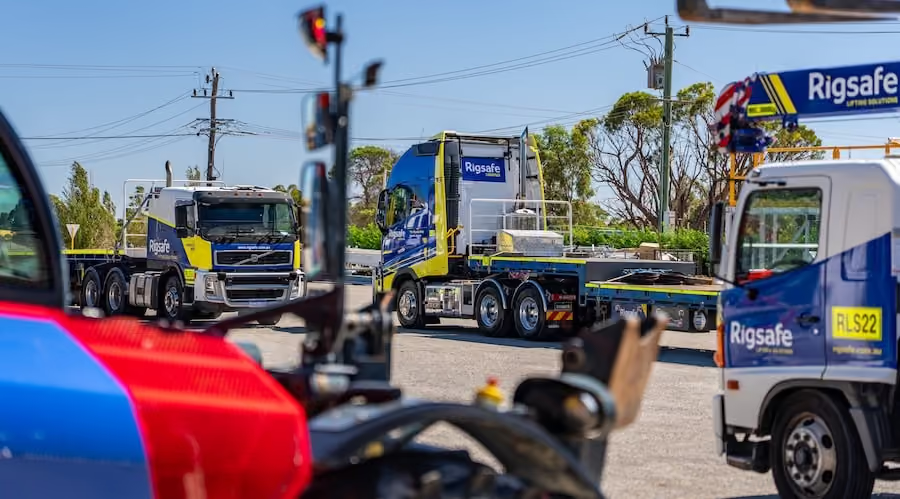
From logistics to lift planning, Rigsafe is targeting the weak links in construction delivery.
From logistics to lift planning, Rigsafe is targeting the weak links in construction delivery.
Over the past 18 months, Rigsafe Lifting Solutions, a Western Australia-based business has taken a deliberate step forward, expanding beyond traditional lifting and rigging services to better control the factors that can slow projects down.
“We’ve really looked at every touchpoint that impacts projects and clients the most,” said Tanya Fitzgerald, Director – Business & Strategy at Rigsafe Lifting Solutions. “And we’re investing heavily in those areas so we can deliver better outcomes.”
That forward planning approach is now shaping how the company operates, from logistics and transport through to engineering, workforce strategy and digital systems.
Bringing logistics in-house
One of the company’s biggest shifts has been the launch of Rigsafe Logistics, a move driven by industry-wide challenges around transport delays and coordination.
“In so many projects, installation is completely dependent on transport, but transport is often controlled by a third party,” Tanya said. “Clients end up working around someone else’s schedule, and that can impact the whole program.”
By bringing transport in-house, Rigsafe now controls a larger portion of the delivery chain, from mobilisation through to installation.
“It was a no-brainer for us,” Tanya said. “If we can control the timing, the sequencing and the delivery, we can remove a lot of those bottlenecks. For our clients, that means greater certainty around timeframes, budgets, and overall project delivery.”
The shift also reflects broader changes in the construction sector, particularly the rise of modular construction, where large components are assembled off-site and lifted into place.
“There’s a huge move towards modular builds, apartments, holiday parks, large-scale developments,” Tanya said. “If anything can be pre-assembled, it saves time and cost. But that only works if the transport and lifting are aligned.”
Recent projects highlight that approach. At the Perth Film Studios development, Rigsafe used a modular methodology to install large roof sections, lifting preassembled components into place to improve efficiency and reduce risk. The project involved more than 1,700 precast elements and 128 roof modules delivered under a compressed program.
Value engineering from the start
While logistics is a new addition to the business, Rigsafe’s core approach has remained consistent: getting involved early and shaping how projects are delivered.
“We’ve always done the value engineering side, we just never really spoke about it,” Tanya said.
That includes lift planning, sequencing and methodology, often before a project is even awarded.
“If we can get involved early, we can help clients shorten programs, reduce risk and make their bids more competitive,” she said. “Sometimes we’re doing that work before we even win the job.”
This “value engineering” mindset has become a key differentiator for the business, supported by digital tools such as CraneBee for lift planning and compliance systems that track site readiness.
This integrated approach allows Rigsafe to compress schedules, reduce rework and deliver more predictable outcomes across projects.
Investing in capability and equipment
Alongside operational changes, Rigsafe has continued to invest in its fleet and internal capability.
“We’ve just added a new 130-tonne crane and we’re continuing to invest in equipment that directly supports what our clients need,” Tanya said.
Some of those investments are being shaped by direct client feedback, particularly in the transport space.
“We’ve spoken to clients about what would actually make their jobs easier and we’re buying equipment based on that,” she said. “It’s about being practical.”
The company has also expanded its team, bringing in a dedicated transport manager and, for the first time, a business development manager.
Preparing for the next wave of demand
Looking ahead, Rigsafe is positioning itself for growth in key sectors, particularly defence and large-scale infrastructure.
The business is Defence Industry Security Program (DISP) ready, a process that has taken more than a year to complete.
“That’s been a huge undertaking,” Tanya said. “But it’s not just about defence work, it’s about best practice in data security and how we manage information.”
At the same time, the company is preparing for increased demand across Western Australia, where major infrastructure, mining and defence projects are expected to place pressure on resources.
“There’s going to be a massive pull on skilled people,” she said. “Attracting and retaining staff is going to be one of the biggest challenges for the industry.”
To address that, Rigsafe has introduced sponsorship pathways for overseas workers and partnered with Indigenous recruitment organisations to build a broader talent pipeline.
A more connected, data-driven business
Another area of focus is digital transformation, with the company exploring how artificial intelligence can improve visibility across projects.
“We’re looking at how we can connect everything, from quoting through to operations and invoicing,” Tanya said. “The more data we have, the better decisions we can make.”
That approach is supported by a strong emphasis on cybersecurity, particularly as more systems are brought in-house.
Growth with purpose
Despite the scale of these changes, Tanya is clear that the strategy is not about expansion for its own sake.
“It’s not growth for growth’s sake,” she said. “It’s about solving problems and making projects run better.”
That philosophy is reflected across the business, from early-stage planning through to delivery on site.
“We’re always asking the same question,” Tanya said. “How do we better service our clients, our crew and our community?”